
A Pattern Hidden in the Numbers: A Breakthrough on Determinants and Infinite Matrix Grids
In real-world applied settings, a matrix is a digital machine—a powerful mathematical tool that transforms data. Matrices rotate 3D objects in computer graphics and transmit data through layers of a neural network; they encrypt messages for cybersecurity and solve large engineering equations; and matrices are the foundational language of quantum computing.


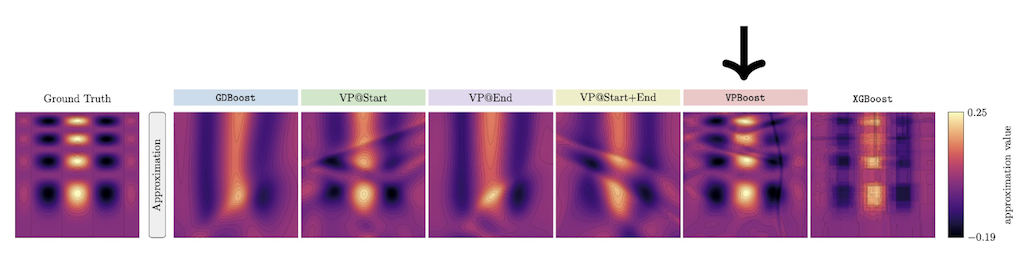
Boost Like a (Var)Pro: How Little Neural Networks Can Achieve Big Performance
The wealth of available data and the rapid advancement and accessibility of computational tools has enabled deep learning to tackle some of the most complex scientific challenges of the day. In order to handle the complexity of such problems, the learned data-driven models have, by design, become massive. Training these models, posed as a high-dimensional non-convex optimization problem, thereby requires significant computational resources. Our project tackles these training challenges by pairing lightweight, structured models with powerful structure-exploiting optimization.
With Exotic Anosov Flows, Researchers Disprove the Venerable Verjovsky Conjecture
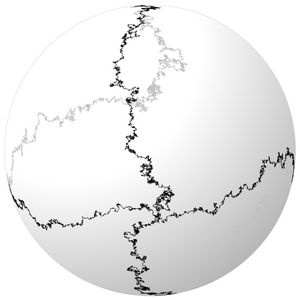
For fifty years, the Verjovsky conjecture held, and mathematicians believed, that a certain chaotic-yet-stable dynamical system — a certain type of Anosov flow, a mathematical model of a complex physical system such as the weather — could not exist in dimensions higher than three.


A Cryptography Breakthrough Rooted in Gödel’s Incompleteness Theorem
IAS researcher Rahul Ilango has published a major conceptual advance in cryptography that relaxes protocol requirements for zero-knowledge proofs. His offering, an “effective” zero-knowledge proof, matches the security guarantees of zero-knowledge proofs in practice while doing away with the need for interaction. To remove this necessity of back-and-forth verification, Ilango turned to a surprising source of insight: Gödel’s incompleteness theorem, one of the greatest – and most astonishing – revelations in modern mathematical logic.
At the Cutting Edge of Stochastic Partial Differential Equations
Stochastic partial differential equations are used to describe and model complex systems — such as heat flow and financial markets — within which change is influenced not just by deterministic variables, but also by random perturbations or “stochasticity.”
The NSF Mathematics Institutes: At the Nexus with AI
In October 2025, a scrum of mathematicians spent a week teaching partial differential equations to a computer, using a proof assistant and programming language called Lean.

Research Highlight: Mathematical Analysis of Many-Body Quantum Simulation with Coulomb Potentials
Efficient simulation of many-body quantum systems, originally proposed as a primary motivation for building quantum computers, remains one of the most fundamental tasks in quantum computing.
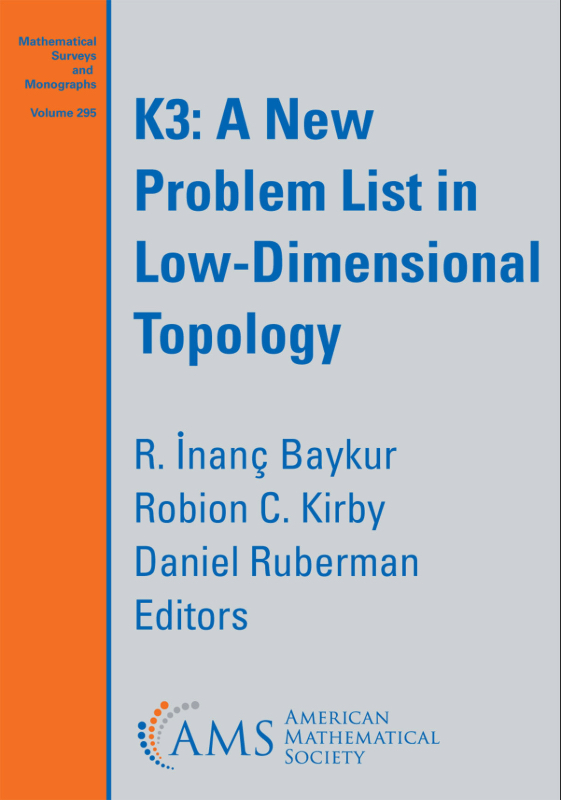
The Importance of a Problem List
The new book K3: A New Problem List in Low-Dimensional Topology grew out of a 2023 AIM workshop designed to create the next version of the famous "Kirby problem lists." Organizers hope that this list, like the previous two, will inspire graduate students and experienced researchers alike, and that it will set the research agenda for the field for the next decade or more.

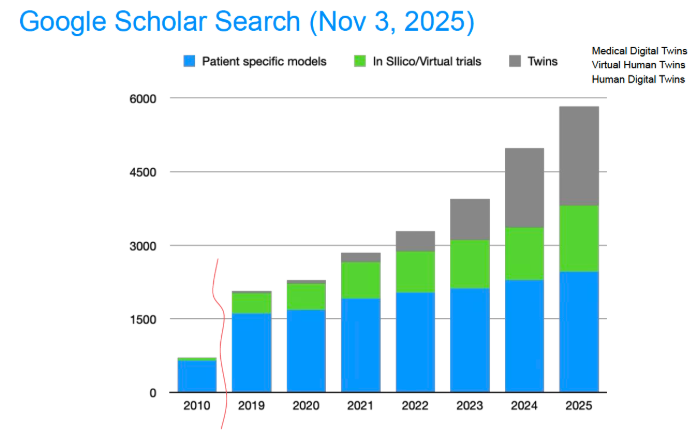
Digital Twins and Personalized Medicine
Digital twins are virtual, data-driven models that replicate physical systems and processes, enabling continuous simulation, prediction, and optimization. In health care, a digital twin of a patient leverages real-time clinical data and computational models to reflect physiology and disease dynamics—allowing clinicians to tailor treatments, manage disease, and enhance outcomes with unprecedented precision.
Homogeneous Dynamics Proof Opens New Doors in Number Theory
A team of mathematicians at the Institute for Advanced Study has released a breakthrough proof that sheds new light on one of number theory’s oldest and most established inquiries. Their achievement highlights the power of a surprising partnership: number theory and dynamical systems.