A Massive hypercube hidden in the Bruhat Order, Found by AI
ICERM - January 2026
by Nicolas Libedinsky
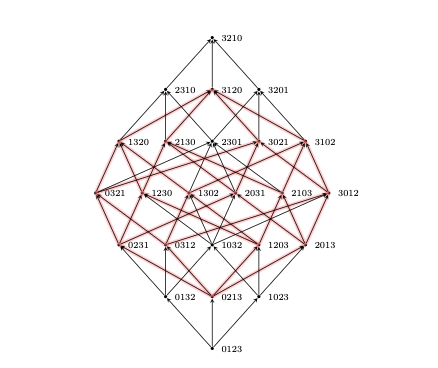
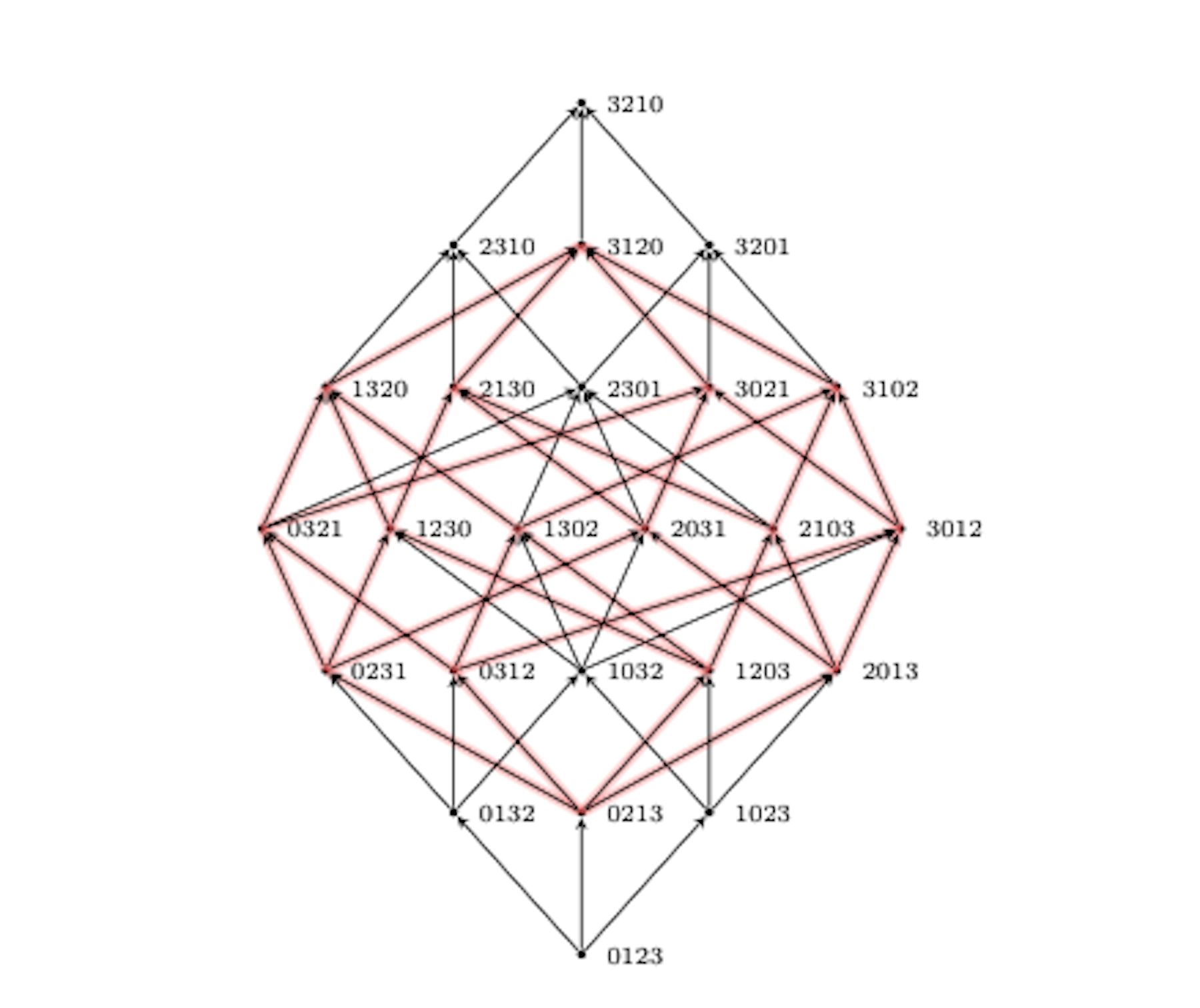
Imagine all possible ways of shuffling numbered cards. Mathematicians organize this enormous set of permutations using a structure called the Bruhat order, which arranges them by declaring τ <σ when a single swap turns τ into σ and increases the deck’s “disorder” in a precise way. This deceptively simple rule has deep consequences in representation theory, geometry, and combinatorics.
Within this highly intricate structure, the authors of Bruhat intervals that are large hypercubes [Ell+25] uncover something exceptionally rigid: a gigantic, perfectly organized hypercube hidden inside the seemingly “chaotic” Bruhat order.
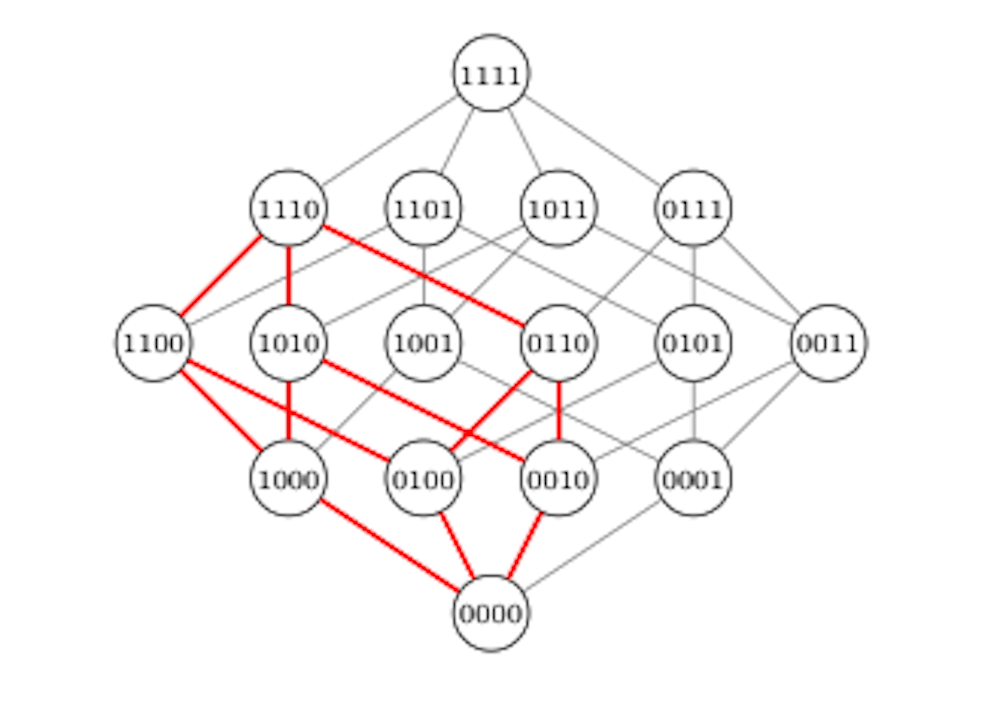
A hypercube of dimension n is the shape whose vertices correspond to all possible choices of n bits, each either 0 or 1. Two vertices are connected when they differ in exactly one of these choices. It is the natural n-dimensional generalization of an ordinary cube. For example, when n = 2, the hypercube is just a square. In the 4-dimensional hypercube shown below, pick any two vertices that are “distance 3” apart, for instance, 0000 and 1110. If you highlight all the shortest paths between them, you will see that they fit together to form an ordinary (3-dimensional) cube.
Finding a large hypercube inside the Bruhat order means finding many permutations whose relationships behave as cleanly and independently as the vertices of a cube. Such objects are known to exist only in small dimensions; constructing large ones has long been viewed as extremely difficult. It is a bit like spotting a perfectly aligned block inside a wildly scrambled Rubik’s cube: small ones are common, but large ones are extraordinarily rare.
The main discovery is that when n is a power of 2, there is a Bruhat interval that is exactly a hypercube of dimension on the order of nlog n, much larger than any previously known family. Moreover, this size is essentially optimal: one cannot build a significantly bigger hypercube inside the Bruhat order of the symmetric group.
Even more striking is which permutations appear as the vertices of this hypercube. They are precisely those whose binary digits are “perfectly distributed at every binary scale.” To explain what this means, recall that a permutation (or shuffling of cards) can be visualized as a matrix indicating where each card ends up after shuffling. For instance, in the example below, the blue shuffle sends card 0 to 0, card 1 to 8, card 2 to 4, and so on. The picture below shows two such permutations: the red one and the blue one. In this example one can see that “perfectly distributed at every binary scale” means that each of the rectangles drawn there contains exactly one entry of the permutation.
Captura de pantalla 2025-11-29 a la(s) 5.49.18 p.m..png197.86 KB This property is known in numerical analysis as forming a (0,m,2)-net. These “digit-balanced” permutations are famous in quasi–Monte Carlo methods [BBG97], where they ensure exceptionally uniform sampling of the unit square. The same objects unexpectedly control a remarkably rigid structure in the Bruhat order, which has, in principle, no relation. This bridge between a deep algebraic order on permutations and ideas from pseudo-random sampling and mathematical finance is conceptually new.
This discovery has several important consequences. It yields a superlinear lower bound, of order nlog n, for the maximal value of the d-invariant in Kazhdan–Lusztig theory (see §3.3 of [Ell+25]). These invariants appear throughout modern representation theory and algebraic geometry. Through recent results linking the d-invariant to the structure of cluster algebras attached to open Richardson varieties, the examples in this paper show that these varieties can have significantly more frozen variables than previously known. The same quantity nlog also governs how large a Bruhat interval can be while still supporting certain particularly well-behaved geometric embeddings.
A final distinctive feature of this work is its origin: the structure was first suggested by an artificial-intelligence system. The authors used AlphaEvolve, an evolutionary coding protocol developed at Google DeepMind, to search for permutations with unusually large d-invariants. Instead of scanning individual permutations (a task that is combinatorially hopeless) AlphaEvolve evolves small computer programs that generate promising examples. For moderate values of n, the system repeatedly produced highly structured permutations with the same digit-balanced form. The authors recognized this pattern, generalized it, and proved that it yields optimal hypercubes for all powers of 2.
Thus the paper is more than a combinatorial construction. It is one of the clearest cases to date in which an AI-guided search uncovered a pattern that led directly to new mathematics with clean conceptual structure, broad connections, and complete human-written proofs. Anyone wanting the normal statements and technical developments can consult the full paper, Bruhat intervals that are large hypercubes.
References
[BBG97] Phelim Boyle, Mark Broadie, and Paul Glasserman. “Monte Carlo methods for security pricing.” In: Journal of economic dynamics and control 21.8-9 (1997), pp. 1267–1321.
[Ell+25] Jordan Ellenberg, Nicolas Libedinsky, David Plaza, José Simental, and Geordie Williamson. “Bruhat intervals that are large hypercubes.” In: arXiv preprint arXiv:2601.01235 (2026).

 5.49.18 p.m._1767720879.png)