
The Importance of a Problem List
AIM - February 2026
A highlight of every AIM workshop is the Monday afternoon moderated problem session during which participants collectively generate a list of open problems. Over the course of about three hours, the group has a lively conversation about the important problems driving the field. By the time happy hour rolls around, they have formulated anywhere from eight to forty-eight open problems. A scribe is charged with writing down careful versions of each problem, and this problem list becomes a lasting outcome of the workshop, a contribution to the current and future research community. Problem lists from past AIM workshops can be found here: https://aimath.org/problemlists/.
For most AIM workshops, the rest of the afternoons are dedicated to forging collaborations and tackling some of those open problems in small groups of four to six people. But the workshop "K3: A new problem list in low-dimensional topology" (held at AIM from October 30 – November 3, 2023) had a different goal: creating a new incarnation of the famous Kirby problem lists and setting the direction for research in low-dimensional topology for the next decade or more.
The organizers describe the history and importance of good problem lists to the field of low-dimensional topology and the impetus for this work in their organizer report:
For most AIM workshops, the rest of the afternoons are dedicated to forging collaborations and tackling some of those open problems in small groups of four to six people. But the workshop "K3: A new problem list in low-dimensional topology" (held at AIM from October 30 – November 3, 2023) had a different goal: creating a new incarnation of the famous Kirby problem lists and setting the direction for research in low-dimensional topology for the next decade or more.
The organizers describe the history and importance of good problem lists to the field of low-dimensional topology and the impetus for this work in their organizer report:
Low-dimensional topology has long been a highly active field, with remarkable achievements and breakthroughs coming at a staggering pace over the last half-century. The subject, comprising knot theory and the study of manifolds of dimensions up to four, has been repeatedly transformed by new ideas coming from hyperbolic geometry, differential geometry, mathematical physics, contact and symplectic geometry, and geometric analysis, as well as advances in traditional topological methods. A fundamental contribution to the progress and unity of the field was played by two problem lists K1 and K2, compiled by Rob Kirby, the second representing a significant expansion and updating of the first. These documents provided a unification of diverse ideas and stimulated and guided research in the field. It is considered a signature achievement to solve a problem from Kirby’s list, and those who do so will usually point it out in their papers. With Rob Kirby providing leadership, many mathematicians contributed problems, and others detailed write-ups that provided background and inspiration for early-career mathematicians.
The workshop brought together a diverse group of senior, mid- and early-career mathematicians who not only have broad mathematical knowledge, but are also leading researchers in their areas and are good at collaborating and communicating with others in their research communities.
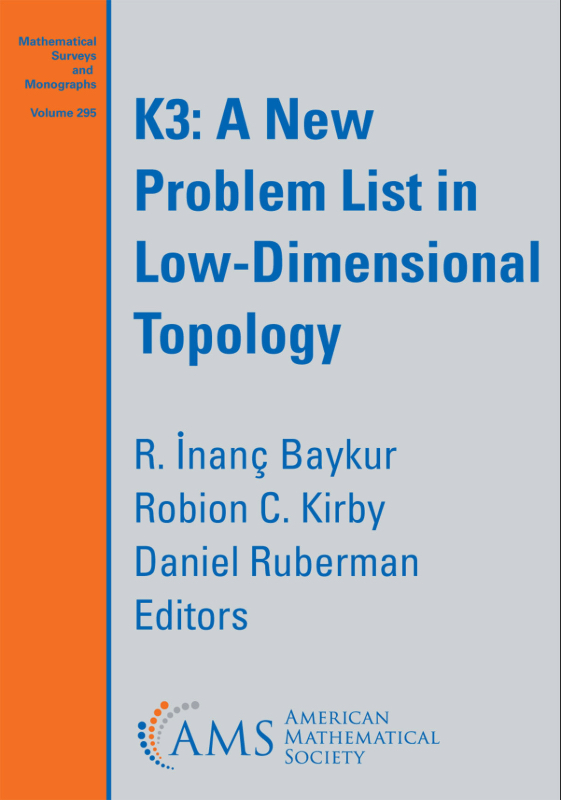
The AMS agreed to publish this new problem list, and they just announced that the book K3: A New Problem List in Low-Dimensional Topology is available for preorder with an expected availablility date of June 10, 2026. Like the K1 and K2 lists, the book is organized roughly by dimension: knot theory, surfaces, 3-manifolds, 4-manifolds, and a brief miscellanea chapter. It features close to 400 problems across a wide range of topics, with nearly a thousand subproblems, questions, and conjectures interspersed throughout.
AIM and the workshop organizers hope that this K3 list will play the same role as the previous lists in stimulating new research across the now mature and broad field of low-dimensional topology.