Stochastic partial differential equations are used to describe and model complex systems — such as heat flow and financial markets — within which change is influenced not just by deterministic variables, but also by random perturbations or “stochasticity.”
“It was a timely moment to bring communities together,” said mathematician Jonathan Mattingly, the Kimberly J. Jenkins Distinguished University Professor of New Technologies and interim director of the Rhodes Information Initiative at Duke University.
“Seeds planted over the last 12 years are coming to fruition, and there’s been a youthful wave of activity,” Dr. Mattingly said. He added: “A synthesis is emerging.”
One recent trend is investigating — within a rigorous mathematical framework — links between SPDEs and quantum field theory (QFT). Martin Hairer, a mathematician at the Swiss Federal Institute of Technology in Lausanne and Imperial College London, explored this topic in his talk on “Fine Properties of Random Fields: From Fluids to Quantum Field Theory.”
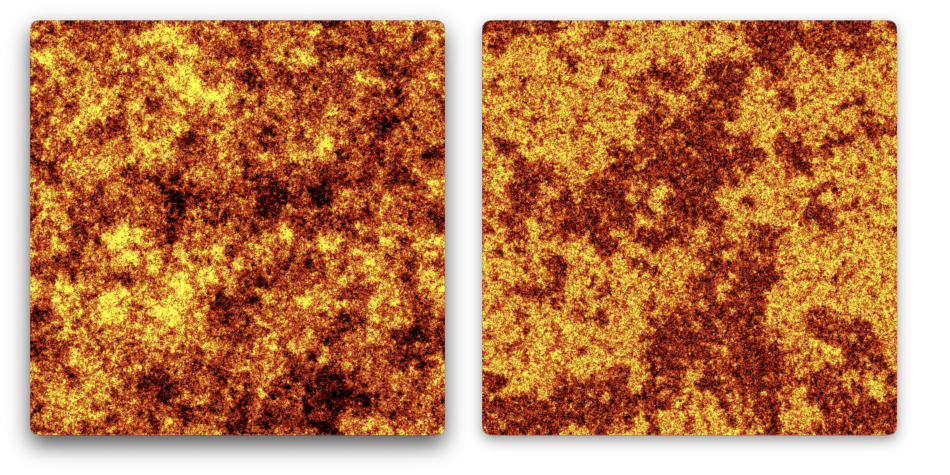
“As mathematicians, we don’t usually come up with new models, that’s more the physicists’ job, said Dr. Hairer. Rather, in this context mathematicians “provide a guarantee that the approximation coded into the computer is actually approximating something, that there is a well-defined limiting mathematical object behind it,” he said. slmath-SPDE-f1-and-f2.png953.72 KBFigure 1 and Figure 2: Snapshots of two different computer-generated random fields obtained from solutions to stochastic partial differential equations (SPDEs). Figure 1 shows an instance of the “free field,” the natural scaling limit obtained from uniformly random continuous functions. Figure 2 shows a snapshot of the “phi-four field” which describes, for example, the behavior of a magnet near its critical temperature — it looks like the free field at small scales but differs at large scales by forming large clusters of similar values. The question of whether a single snapshot (of infinite resolution) can distinguish between these two fields with absolute certainty is closely related to the question of glueing together quantum field theories in adjacent patches of space-time. CREDIT: Martin Hairer
It was Dr. Hairer’s research, for which he won a Fields Medal in 2014, that cracked open this field. His theory of regularity structures allows rigorous treatment of singular SPDEs: equations that lack classical solutions due to highly irregular noise (such as space-time white noise). Dr. Hairer not only showed how to reformulate previously ill-defined equations, thus making them mathematically meaningful; he also established that these reformulations admit unique solutions.
This breakthrough marked a sharp transition in the field, opening more than a decade — and counting — of new research devoted to analyzing more singular stochastic systems.
For instance, the work of mathematician Oleg Butkovsky and collaborators targets a further relaxation of regularity constraints by zooming and looking at local behavior with a tool called the stochastic sewing lemma (first introduced by Khoa Lê in 2020, after the deterministic version by Massimiliano Gubinelli in 2003).
Dr. Butkovsky, at the Weierstrass Institute for Applied Analysis and Stochastics in Berlin, has applied this lemma to expand the kind of stochastic equations — especially those with rough data — that can be rigorously constructed and studied. The lemma provides a means of assembling, or sewing together, integrable increments into full-fledged solutions, even when those increments lack the regularity necessary for classical arguments.
During the SLMath Fall 2025 programs, Dr. Butkovsky leveraged the opportunity to brainstorm with key researchers, among them Dr. Mattingly and Lorenzo Zambotti, lead organizer of the “Recent Trends in Stochastic Partial Differential Equations” program and a professor at the Laboratory of Probability, Statistics and Modeling at CNRS Sorbonne University in Paris.
“We have different expertise in three different directions,” Dr. Butkovsky said. “Together, with our expertise combined, we managed to overcome the main obstacle.”
“We’ve already used a combination of two ideas to prove a version of the result we desire,” Dr. Mattingly said. One idea builds on his earlier work with a collaborator and uses the same base that Dr. Hairer built from in his research on links between SPDEs and quantum field theory. “The other idea we’re using builds on much older work, but with a new twist to deal with the low regularity of the solutions,” Dr. Mattingly said.
Such progress indicates that even with complex systems full of randomness and irregular behavior there exist new ways to understand how things eventually settle down into stable, predictable long‑term patterns.
Adding stochastic terms to, for example, the famed Navier-Stokes equations — the fundamental mathematical rules governing how fluids such as liquids and gases flow — creates an SPDE wherein the random terms capture the messy and chaotic properties of turbulence.
Advances in the SPDE theory and the mathematical analysis of SPDEs improve researchers’ ability to model complex systems, such as interacting organisms at all scales, from viruses to birds to crowd dynamics.
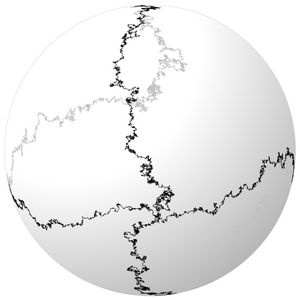
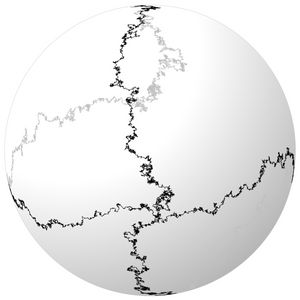
slmath-SPDE-figure-3-Martin-Hairer.jpg9.66 KBFigure 3: A representation of the solution to a stochastic partial differential equation (SPDE). Specifically, it is the solution to the geometric stochastic heat equation with values in the sphere at a fixed time. In finance, the stochastic heat equation and related SPDEs are used to model how prices evolve over time under constant random shocks (such as the news, and other “noise” driving unpredictable market fluctuations), much like heat diffusing through a randomly jostled material. CREDIT: Martin Hairer