
Skeletons of Quantum Symmetries
ICERM - August 2026
by Sarah Brauner (University of Pennsylvania), Zajj Daugherty (Reed College), Sarah Mason (Wake Forest University), and Anne Schilling (University of California, Davis)
A common story in mathematics is the following: you have a large set of data, and want to find a strategic way to group that data together that makes it simpler to understand. The challenge here is to find a good way to group things that actually distills the information you have, and removes some of the “noise” of the full data set. For example, if your data set measures income by address in a city, it might make sense to group data points by neighborhood, but grouping neighborhoods this way might oversimplify the situation. On the other hand, grouping data by block might be too granular, and not simplify the data enough.
A common story in mathematics is the following: you have a large set of data, and want to find a strategic way to group that data together that makes it simpler to understand. The challenge here is to find a good way to group things that actually distills the information you have, and removes some of the “noise” of the full data set. For example, if your data set measures income by address in a city, it might make sense to group data points by neighborhood, but grouping neighborhoods this way might oversimplify the situation. On the other hand, grouping data by block might be too granular, and not simplify the data enough.
What are skeletons of quantum symmetries? At its core, this article on Skeletons of Quantum Symmetries follows an analogous model, albeit with a more abstract data set. The data in question is given by a crystal, which is a discrete data set describing certain types of symmetries called quantum symmetries involving a quantum parameter q. The name crystal comes from the fact that the discrete information is captured when a quantum parameter q approaches 0, i.e. “freezes” (or crystalizes). An example of a crystal is shown below in Figure 1 on the left. The discrete data is a graph, where both the vertices and edges contain important information about the quantum symmetries of interest.
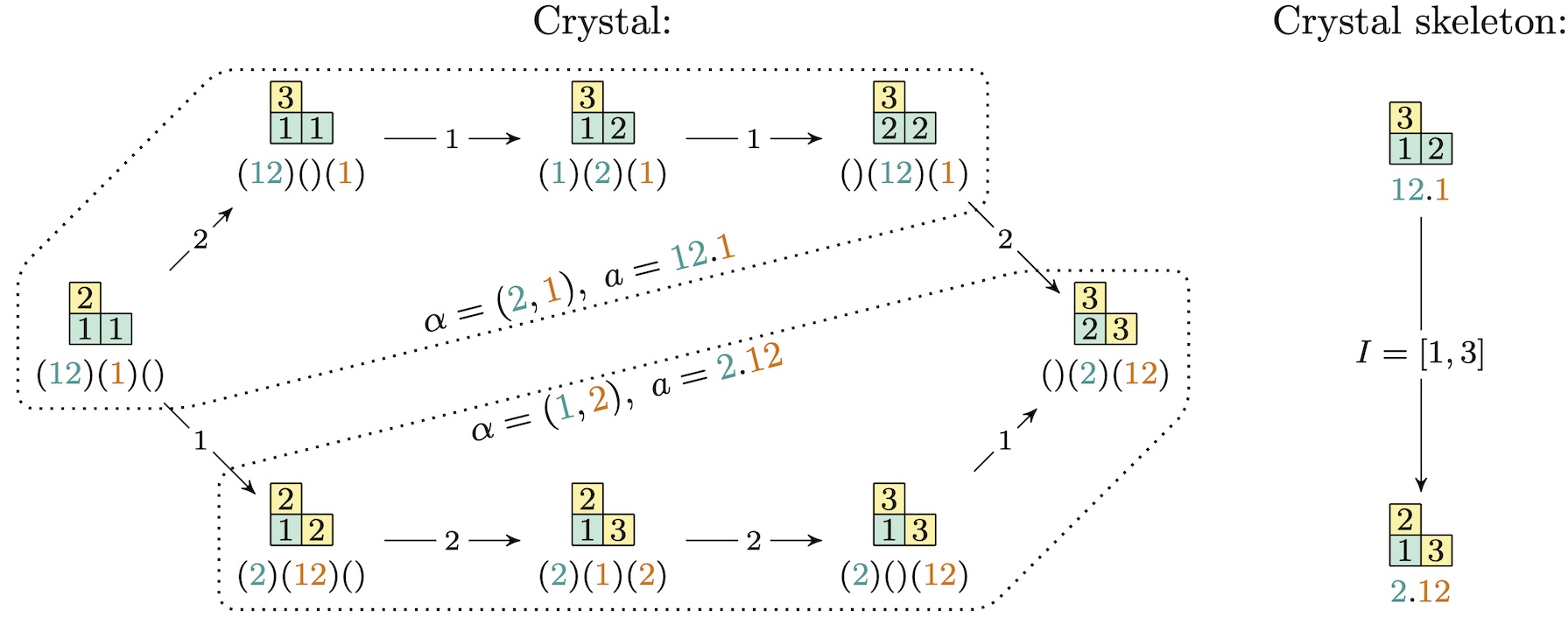
Figure 1. On the left, a crystal when n = 3. On the right, the corresponding crystal skeleton.
The crystal in Figure 1 is relatively small, because it relates to symmetries of only n = 3 objects. However, as n gets larger, these graphs quickly increase in size and complexity. This is where the skeleton comes in. We would like to group parts of the crystal graph together by “type,” and then “contract” all of the vertices of the same type together. One can think about contraction as turning every vertex of the same type into one point. In other words, we create a new, smaller graph whose vertices are the possible types and whose edges are the edges from the original crystal graph that connected vertices with different types. This is shown on the right in Figure 1. The contracted, smaller graph is called the crystal skeleton because it is a skeleton of the original crystal. To tie this in with our “neighborhoods” analogy, think of the edges in our skeleton as being major roads connecting neighborhoods where we ignore some of the lesser surface streets.
The crystal in Figure 1 is relatively small, because it relates to symmetries of only n = 3 objects. However, as n gets larger, these graphs quickly increase in size and complexity. This is where the skeleton comes in. We would like to group parts of the crystal graph together by “type,” and then “contract” all of the vertices of the same type together. One can think about contraction as turning every vertex of the same type into one point. In other words, we create a new, smaller graph whose vertices are the possible types and whose edges are the edges from the original crystal graph that connected vertices with different types. This is shown on the right in Figure 1. The contracted, smaller graph is called the crystal skeleton because it is a skeleton of the original crystal. To tie this in with our “neighborhoods” analogy, think of the edges in our skeleton as being major roads connecting neighborhoods where we ignore some of the lesser surface streets.
The vertices of the crystal in Figure 1 are represented by diagrams whose boxes are filled by the numbers 1, 2, and 3 (in general, by the set {1, 2, . . . , n}), with repeated use of numbers allowed. These are called semi-standard Young tableaux. On the other hand, the vertices of the crystal skeleton (our data “types”) are represented by diagrams whose boxes are filled by the set {1, 2, . . . , n}, but with no repeats allowed. These are called standard Young tableaux, and are a special case of semi-standard Young tableaux. Although to the untrained eye these might just look like pieces of a sudoku puzzle, semi-standard Young tableaux encode a large amount of information. In fact, they model fundamental symmetries in mathematics, and the labels in the crystal directly describe properties of the aforementioned quantum symmetries.
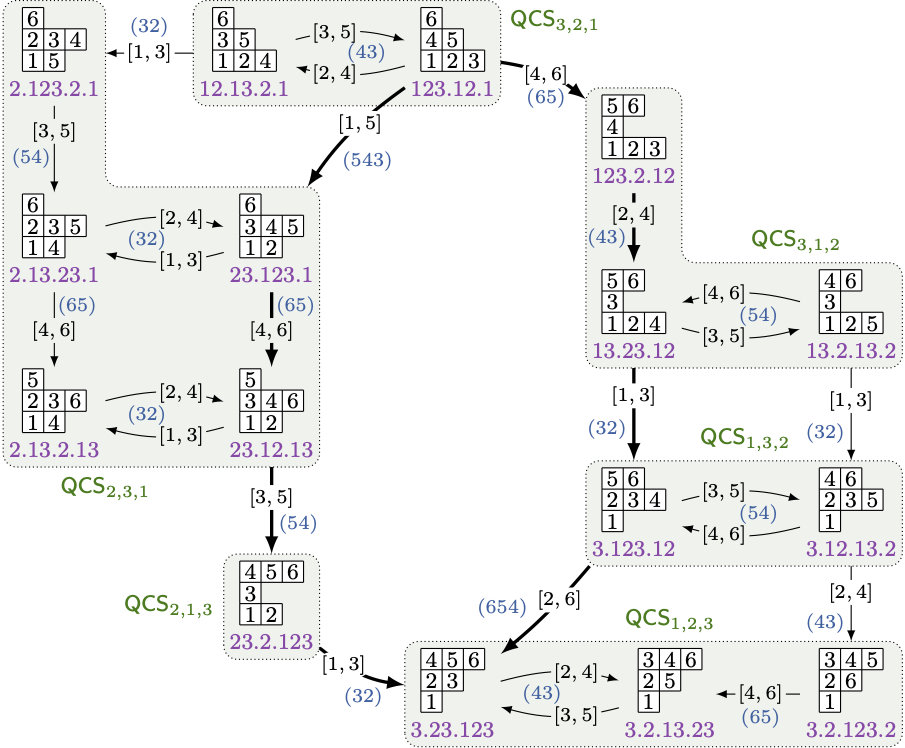
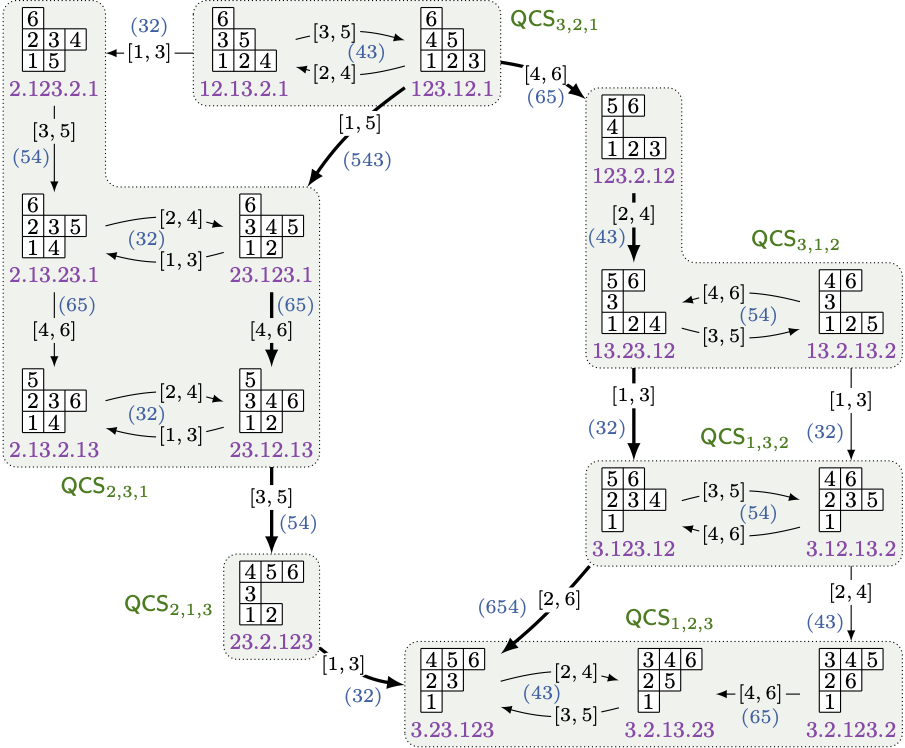
Figure 2. A crystal skeleton when n = 6. The shaded regions indicate data points of the same type, using ideas from [3].
What happened at ICERM: The crystal skeleton was introduced by Florence Maas-Gariépy in her PhD thesis [1]. In principle, one can always arbitrarily group the objects in a data set; the important question becomes whether this choice of grouping has mathematical significance. Specifically in this case, we must ask whether contracting the data of the crystal to the crystal skeleton (1) preserves the most prescient features of the crystal, while also (2) simplifying the data we are analyzing.
This is precisely the question that the authors found themselves considering at ICERM; in fact, they discovered that the crystal skeleton could be naturally contracted even further. In previous work, Sarah Brauner, Sylvie Corteel, Zajj Daugherty, and Anne Schilling had studied the properties of the crystal skeleton and constructed it without reference to the original crystal [2], helping to make the case that the answers to both of the above questions are yes.
In fall 2025, Brauner, Daugherty, and Schilling were in residence at ICERM as part of the semester program “Categorification and Computation in Algebraic Combinatorics”. Sarah Mason was also in residence and during a coffee break one day in September, they began to talk. Together, they discovered that the quasisymmetric Schur functions [3] Mason had been working with suggested a logical way to further group the crystal skeleton into types. (In other words, a way to contract the crystal twice.) The four of them got together and worked for the rest of the semester on describing how this new grouping tiled the crystal skeleton, resulting in the paper [4]. An example is shown in Figure 2 for a larger crystal skeleton (here n = 6; the corresponding crystal is too large to fit on a page).
Long-term goals: Ultimately, the research group would like to use the crystal skeleton and its further contractions to answer novel questions in combinatorics related to symmetry. In particular, a central goal of algebraic combinatorics is to describe certain functions called symmetric functions in terms of smaller building blocks called Schur functions. This problem can be rephrased in terms of identifying connected components of a larger crystal. The new question of the research group is the following: since the crystal skeleton distills the data of the crystal, can this problem be solved using this new, smaller graph? The full group will come together at ICERM in June 2027 to attack this problem as part of the Collaborate@ICERM program.
References
[1] Maas-Gariépy, Florence. Quasicrystal structure of fundamental quasisymmetric functions, and skeleton of crystals. Preprint, https://arxiv.org/abs/2302.07694
[2] Sarah Brauner, Sylvie Corteel, Zajj Daugherty, and Anne Schilling. Crystal skeletons: Combinatorics and axioms. Algebraic Combinatorics, to appear: https://arxiv.org/abs/2503.14782
[3] J. Haglund, K. Luoto, S. Mason, and S. van Willigenburg. Quasisymmetric Schur functions. J. Combin. Theory Ser. A, 118(2):463–490, 2011.
[4] Sarah Brauner, Zajj Daugherty, Sarah Mason, and Anne Schilling. Contractions and applications of crystal skeletons: Young quasisymmetric and Stanley symmetric functions. Preprint, https://arxiv.org/abs/2607.12232
(S. Brauner) Department of Mathematics, University of Pennsylvania, Philadelphia, PA, USA
Email address: [email protected]
(Z. Daugherty) Department of Mathematics and Statistics, Reed College, 3203 SE Woodstock Blvd, Portland, OR 97202-8199, USA
Email address: [email protected]
(S. Mason) Wake Forest University, 1834 Wake Forest Road, Winston-Salem, NC, USA
Email address: [email protected]
(A. Schilling) Department of Mathematics, University of California, One Shields Avenue, Davis, CA 95616-8633, USA
Email address: [email protected]