
Digital Twins and Personalized Medicine
IMSI - February 2026
Digital Twins and Personalized Medicine
Digital twins are virtual, data-driven models that replicate physical systems and processes, enabling continuous simulation, prediction, and optimization. In health care, a digital twin of a patient leverages real-time clinical data and computational models to reflect physiology and disease dynamics—allowing clinicians to tailor treatments, manage disease, and enhance outcomes with unprecedented precision.
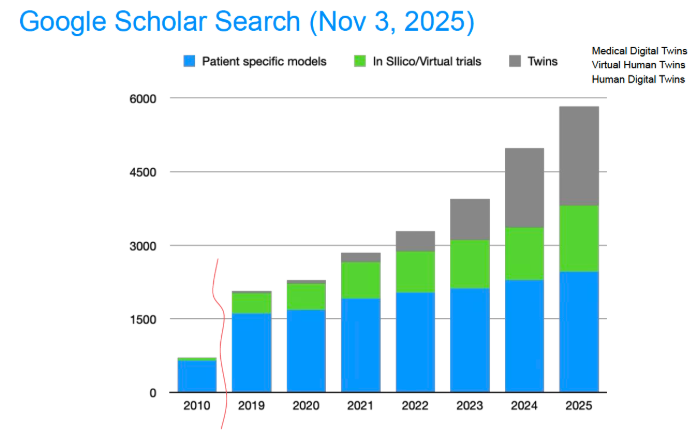
In the Fall of 2025, the Institute for Mathematical and Statistical Innovation (IMSI) hosted a Long Program on Digital Twins. The Long Program focused on the mathematical, statistical, and computational challenges and potential presented by digital twins (DTs). In addition to covering the current state of the science and research directions, the Long Program explored state of the art applications of DTs to problems arising in complex systems in science, engineering, technology, medicine, and beyond. The workshop was partially motivated by recent National Academies of Science, Engineering, and Medicine reports, which have provided a conceptual framework and galvanized much of the current research in the field; as well as by the dramatic growth in research on computational tool in medicine (with DT research contributing the most to this growth over the past 7+ years – See Figure 1). This highlight will summarize progress in the development of DTs for use in personalized medicine, one of the promising and more visible potential applications of digital twins.
Digital twin technologies are transforming personalized medicine by developing tools that synthesize streams of patient-specific information: medical records, genomic profiles, imaging, sensors, and environmental parameters. The goal is a dynamic representation that adapts as the patient’s condition evolves. Clinicians, DT researchers, and patients are collaborating to develop digital twins that model therapeutic responses and adjust interventions proactively, leading to more effective and individualized care. Notable applications include predicting a patient’s reaction to drugs and surgery, updating disease models as conditions progress, and supporting risk-based prevention strategies.
Developing DTs for medicine involves an array of mathematical and statistical challenges. Models must operate across biological scales—from molecules and cells up to organs and whole systems—using tools such as differential equations, stochastic processes, agent-based simulations, and network theory. Personalizing these models to patients is especially difficult; it’s an inverse problem that requires statistical inference, Bayesian estimation, optimization, and regularization methods to deal with data limitations and variability.
Data fusion is another complexity, as DTs must integrate structured information (like lab results) with unstructured sources (like sensor streams or medical images) across different time and spatial scales. This calls for advanced techniques in data assimilation, tensor decomposition, multimodal fusion, and dimensionality reduction. Uncertainty—arising from biological variability and measurement error—requires rigorous quantification and sensitivity analysis. Maintaining real-time efficacy demands model reduction techniques, computational efficiency, and scalable algorithms. For clinical deployment, thorough validation, benchmarking, and interpretable artificial intelligence are critical, ensuring predictions are understandable by practitioners and trustworthy among patients and doctors.
Ethical and privacy issues are central to the responsible use of digital twins. Patient models must embody fairness, confidentiality, and transparency, with increasing adoption of federated learning and differential privacy solutions. Regulatory agencies such as the FDA are responding by refining evaluation frameworks and criteria. In her talk during the final Long Program workshop, on applications of DTs, Tina Morrison (EQTY Lab, formerly FDA) observed that many models labeled as digital twins lack full, bidirectional synchronization with patients. Many of the computational constructs called “digital twins” fall under the regulatory purview of “software as a medical device.” Accordingly, the FDA is developing “score cards” to judge digital twin maturity, weighing fidelity, clinical relevance, validation standards, and ethical requirements. DTs increasingly contribute in silico evidence to support regulatory submissions and in silico clinical trials, but acceptance among doctors, ongoing patient engagement, and evidence of improved health outcomes are essential for future credibility.
Recent developments in cardiovascular and pulmonary medicine illustrate the real-world potential of DTs. In his talk during the applications workshop, Charles Taylor (UT Austin) chronicled the evolution of heart digital twins—most prominently, the HeartFlow platform, which applies computational fluid dynamics and coronary CT imaging to derive a patient’s fractional flow reserve (FFRCT). These models, enabled by artificial intelligence, influence diagnostic pathways and treatment for coronary artery disease and have seen widespread clinical adoption. Taylor also discussed work on lung digital twins, built from patient CT scans and realistic boundary conditions, that simulate airflow and drug delivery for complex conditions like COPD and pulmonary fibrosis. Clinicians use patient data from electrical impedance tomography as one tool to establish model validation, which should improve tools for personalized ventilation and inhaled therapies (see Figure 2).
As digital twins mature, their application in personalized medicine is likely to grow, energized by richer data, computational innovation, and evolving regulatory attitudes and approaches. Continued interdisciplinary work—and rigorous mathematical and clinical validation—will be necessary to overcome current challenges. Examples in cardiovascular and pulmonary care foreshadow digital twins as a foundational technology for future precision health, shaping medical decisions around the individual for more reliable and effective patient care.

