A Look at Representations of SL(2,q) Via the Lens of Size: Motivations, Rank, Eta Correspondence
Presenter
November 4, 2025
Abstract
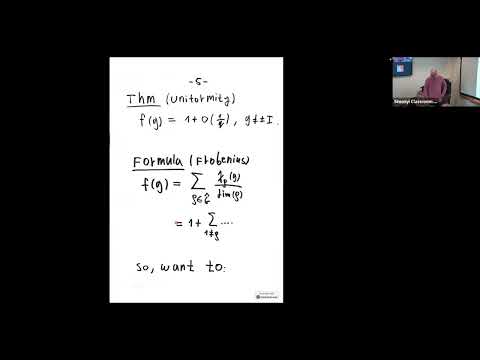
Harmonic analysis studies functions on the real line by expanding them as sums of frequencies (exponentials) and analyzing how each term contributes to the whole. In many applications—such as speech recognition—only the low frequencies matter. Over the last fifty years, Roger Howe (Yale) has developed the philosophy that such “analysis by frequency” should apply far beyond the real line. In joint work with Roger, we have introduced an analogue of this theory for finite classical groups. A class function on a finite group can be expressed as a linear combination of irreducible characters, and we define a notion of “frequency” or “size” (which we call rank) for such objects. This provides a new way to analyze class functions on finite groups. For example, before our work, it was not even clear in what terms one could bound the values of irreducible characters on various group elements. In this talk, I will try to sell you on this approach through the first nontrivial example of the group SL(2,q) of 2×2 matrices with entries in the finite field Fq and determinant equal to one.