Slicing Spaces: From Contour Lines to Morse Theory - A Historical Perspective
Presenter
November 7, 2025
Abstract
It is often said that a geometer has only two basic tools to study a space: to slice it or to project it. Cartography provides a vivid example: contour lines are simply the intersections of a landscape with horizontal planes.
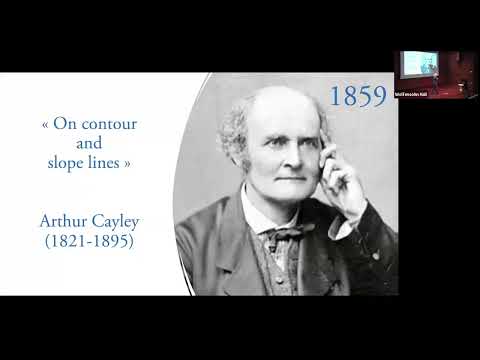
In the nineteenth century, pioneers began to explore how these contour lines change as altitude varies: Cayley in 1859, then Möbius in 1863. Poincaré also used this technique, though only en passant, without developing it into a systematic theory.
It was Marston Morse, in 1925, who took the decisive step of generalizing this approach to spaces of all dimensions. What we now call Morse theory soon became a remarkably powerful tool, especially in the hands of later mathematicians such as René Thom, John Milnor, and Stephen Smale.
In this elementary talk, Étienne Ghys will trace the emergence and development of these ideas over roughly a century.
Étienne Ghys is Emeritus Director of Research at CNRS and Permanent Secretary of the French Academy of Sciences.