Michael Eikerling - Local Reaction in Electrocatalytic Media: Interface Theory, Realism, Complexity
Presenter
October 27, 2025
Abstract
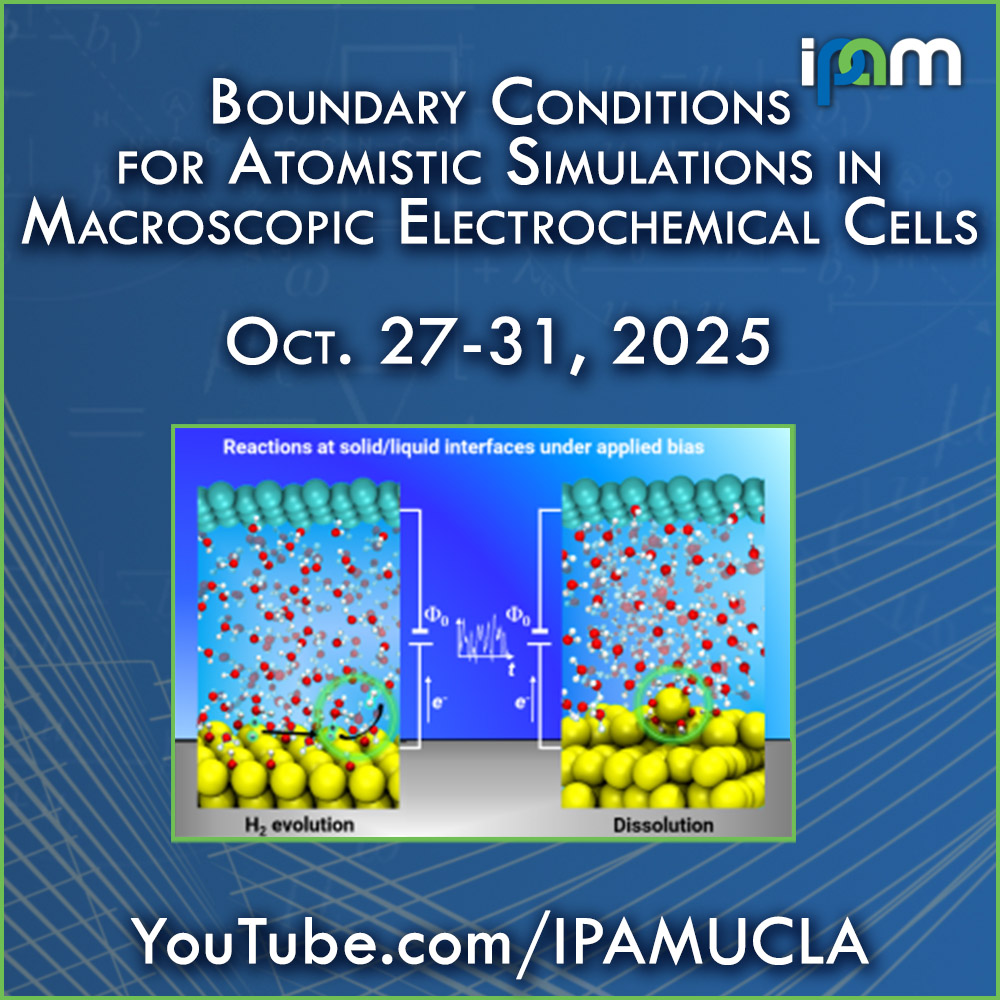
Recorded 27 October 2025. Michael Eikerling of RWTH Aachen University presents "The Local Reaction Environment in Electrocatalytic Media: Infusing Interface Theory with Realism and Complexity" at IPAM's Boundary Conditions for Atomistic Simulations in Macroscopic Electrochemical Cells Workshop.
Abstract: The microscopic region at the contact of an electrified metal surface with an electrolyte, known as electric double layer (EDL), controls the capacitive interface response as well as the kinetics of electrocatalytic reactions.[1,2] Understanding and predicting the all-important local reaction environment in the EDL region is, therefore, of central importance for the performance of electrochemical energy devices.[3] Approaches towards this end must handle the interplay of metal electronic structure, adsorbates, solvent molecules, and ionic species, with all of the involved species and phenomena treated self-consistently as a function of electrode potential.[4] A recently developed hybrid quantum-classical approach, termed density-potential functional theory (DPFT), serves as a foundation of our efforts in this realm.[5] The theory will be introduced in broad strokes and its capabilities in rationalizing capacitive and electrode kinetic phenomena at electrochemical interfaces will be demonstrated. Ensuing from this approach, we have developed a model for supported electrocatalyst nanoparticles (NP).[6] It captures concurrent electronic and ionic equilibria in the three-component system of catalyst NP, support and electrolyte. Results of this model will be presented that reveal how the support induces perturbations in local electronic and ionic charge densities at the surface of the NP, shaping its capacitive response and electrocatalytic activity. The final part of the presentation shifts the focus towards an advanced field-theoretic treatment of electron-ion correlations at interfaces, which is a variation on the method of image charges.[7] Taking EDL theory beyond mean-field level, the proposed framework achieves quantitative agreement with experimental capacitance data and it resolves long-standing questions left unanswered by well-known classical double layer theories. The framework conceptually unifies the processes of double-layer charging and electrosorption.
References:
[1] M.J. Eslamibidgoli and M. H. Eikerling (2018). Approaching the Self-Consistency Challenge of Electrocatalysis with Theory and Computation. Curr. Opin. Electrochem. 9, 189−197.
[2] K. Schwarz and R. Sundararaman (2020). The Electrochemical Interface in First-Principles Calculations. Surf. Sci. Rep. 75, 100492.
[3] V.R. Stamenkovic et al. (2017). Energy and Fuels from Electrochemical Interfaces. Nat. Mater. 6, 57−69.
[4] C. Zhang et al. (2023). Roadmap on Molecular Modelling of Electrochemical Energy Materials. J. Phys. Energy 5, 041501.
[5] J. Huang et al. (2021). Grand-Canonical Model of Electrochemical Double Layers from a Hybrid Density Potential Functional. J. Chem. Theory Comput. 17, 2417−2430.
[6] Y. Zhang et al. (2025). Theory of Electro-Ionic Perturbations at Supported Electrocatalyst Nanoparticles. Phys. Rev. Lett. 134, 066201.
[7] N. Bruch et al. (2025). Classical theory of electron-ion correlations at electrochemical interfaces: Closing the circuit from double-layer charging to ion adsorption. arXiv 2507, 14751.
Learn more online at: https://www.ipam.ucla.edu/programs/workshops/workshop-iii-boundary-conditions-for-atomistic-simulations-in-macroscopic-electrochemical-cells/