Abstract
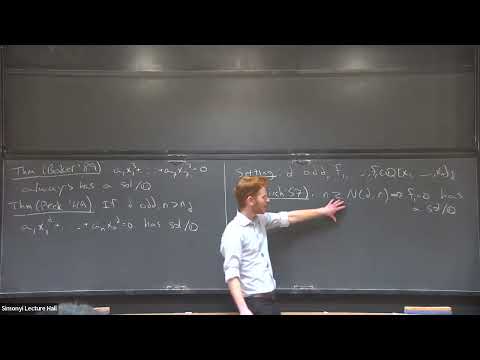
Consider a collection of forms of odd degree with rational coefficients. Birch proved in 1957 that if the number of variables is sufficiently large, then the forms must have a nontrivial rational zero. The bounds resulting from Birch's proof, however, are so large that he has described them as "not even astronomical". We prove that, for any fixed odd degree, the number of variables may be taken polynomial in the number of equations. This was previously known only in degree three, by a result of Schmidt from 1982. We will review Birch's original argument, discuss a stronger result by Schmidt and sketch the proof of our theorem. Joint work with Andrew Snowden and Tamar Ziegler.