Kinetic Theory: Novel Statistical, Stochastic and Analytical Methods: Diffusive behaviour of some linear kinetic equations
Presenter
October 20, 2025
Keywords:
- Kinetic theory and Stochastic particle systems
- mean field plasma and radiation dynamics
- Boltzmann and Landau type equations and systems
- hydrodynamic limits
- enhanced dissipation
- quasi-neutral limits
- swarming and flocking
- mean-field games
MSC:
- 35Bxx - Qualitative properties of solutions to partial differential equations
- 35Lxx - Hyperbolic equations and hyperbolic systems {For global analysis
- see 58J45}
- 35Q20 - Boltzmann equations {For fluid mechanics
- see 76P05
- for statistical mechanics
- see 82B40
- 82C40
- 82D05}
- 35Q35 - PDEs in connection with fluid mechanics
- 35Q40 - PDEs in connection with quantum mechanics
- 35Q49 - Transport equations {For calculus of variations and optimal control
- see 49Q22
- for fluid mechanics
- see 76F25
- see 82C70
- 82D75
- for operations research
- see 90B06
- for mathematical programming
- see 90C08}
- 35Q70 - PDEs in connection with mechanics of particles and systems of particles
- 35Q82 - PDEs in connection with statistical mechanics
- 35Q83 - Vlasov equations {For statistical mechanics
- 82D75}
- 35Q84 - Fokker-Planck equations {For fluid mechanics
- see 76X05
- 76W05
- see 82C31}
- 35Q89 - PDEs in connection with mean field game theory {For calculus of variations and optimal control
- see 49N80
- for game theory
- see 91A16}
- 35Q91 - PDEs in connection with game theory
- economics
- social and behavioral sciences
- 35Q92 - PDEs in connection with biology
- chemistry and other natural sciences
- 60Gxx - Stochastic processes
- 60Hxx - Stochastic analysis [See also 58J65]
- 70Fxx - Dynamics of a system of particles
- including celestial mechanics
- 70Lxx - Random and stochastic aspects of the mechanics of particles and systems
- 82D05 - Statistical mechanics of gases
- 82D10 - Statistical mechanics of plasmas
Abstract
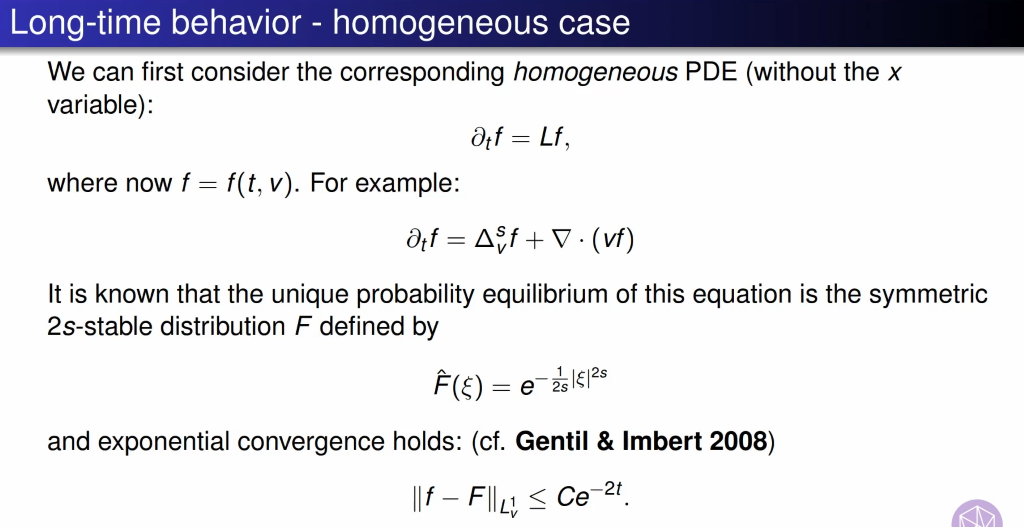
We consider linear kinetic equations of the form $\partial_t f + \frac{1}{\epsilon} v \nabla_x f = \frac{1}{\epsilon^2} L(f)$, for an unknown $f$ which depends on time $t$, position $x$ and velocity $v$, and where $L$ is a linear operator which acts only in the velocity variable, and which typically has a probability equilibrium in $v$. Important examples include the Fokker-Planck operator, nonlocal diffusion operators, linear BGK-type operators, or linear Boltzmann operators. This PDE typically represents a mesoscopic physical model, where we keep track of the probability distribution of the position and velocity of particles. It is well known that when $\epsilon$ tends to $0$, this type of equation has a macroscopic or diffusive limit for the density $\rho(t,x) := \int f(t,x,v) dv$, which is either the standard heat equation, or the fractional heat equation. As a new result, we show that for a fixed epsilon, the behaviour of this equation for large times also follows the standard or fractional heat equation, and that the long-time and small-epsilon limits are actually interchangeable in many cases. This is a work in collaboration with Stéphane Mischler (U. Paris-Dauphine) and Niccolò Tassi (U. Granada).