Kinetic Theory: Novel Statistical, Stochastic and Analytical Methods: Critical trajectories in kinetic geometry
Presenter
October 20, 2025
Keywords:
- Kinetic theory and Stochastic particle systems
- mean field plasma and radiation dynamics
- Boltzmann and Landau type equations and systems
- hydrodynamic limits
- enhanced dissipation
- quasi-neutral limits
- swarming and flocking
- mean-field games
MSC:
- 35Bxx - Qualitative properties of solutions to partial differential equations
- 35Lxx - Hyperbolic equations and hyperbolic systems {For global analysis
- see 58J45}
- 35Q20 - Boltzmann equations {For fluid mechanics
- see 76P05
- for statistical mechanics
- see 82B40
- 82C40
- 82D05}
- 35Q35 - PDEs in connection with fluid mechanics
- 35Q40 - PDEs in connection with quantum mechanics
- 35Q49 - Transport equations {For calculus of variations and optimal control
- see 49Q22
- for fluid mechanics
- see 76F25
- see 82C70
- 82D75
- for operations research
- see 90B06
- for mathematical programming
- see 90C08}
- 35Q70 - PDEs in connection with mechanics of particles and systems of particles
- 35Q82 - PDEs in connection with statistical mechanics
- 35Q83 - Vlasov equations {For statistical mechanics
- 82D75}
- 35Q84 - Fokker-Planck equations {For fluid mechanics
- see 76X05
- 76W05
- see 82C31}
- 35Q89 - PDEs in connection with mean field game theory {For calculus of variations and optimal control
- see 49N80
- for game theory
- see 91A16}
- 35Q91 - PDEs in connection with game theory
- economics
- social and behavioral sciences
- 35Q92 - PDEs in connection with biology
- chemistry and other natural sciences
- 60Gxx - Stochastic processes
- 60Hxx - Stochastic analysis [See also 58J65]
- 70Fxx - Dynamics of a system of particles
- including celestial mechanics
- 70Lxx - Random and stochastic aspects of the mechanics of particles and systems
- 82D05 - Statistical mechanics of gases
Abstract
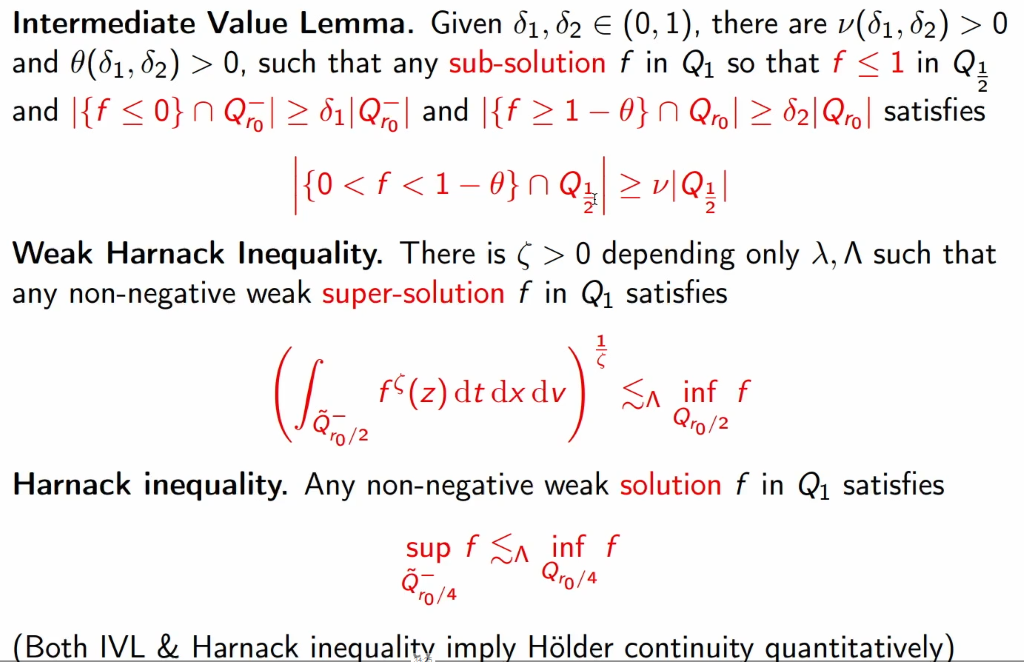
We construct critical trajectories in kinetic geometry, i.e. curves in (t,x,v) that are tangential to the transport and v-gradient, connecting any two given points, respecting the underlying kinetic scaling, and matching scaling properties of the stochastic trajectories near the starting point. The construction is based on solving the laws of motions with a forcing made up of desynchronised logarithmic oscillations. These critical trajectories provide an ''almost exponential map'' that allows to prove several functional analytic estimates. In particular they allow to extend to the kinetic setting the universal estimate for the logarithm of positive supersolutions by Moser 1971, and deduce optimal (weak) Harnack inequalities.