Nicolas Hörmann - Bias In, Physics Out: Ab-Initio Insights into Electrified Interfaces
Presenter
September 18, 2025
Abstract
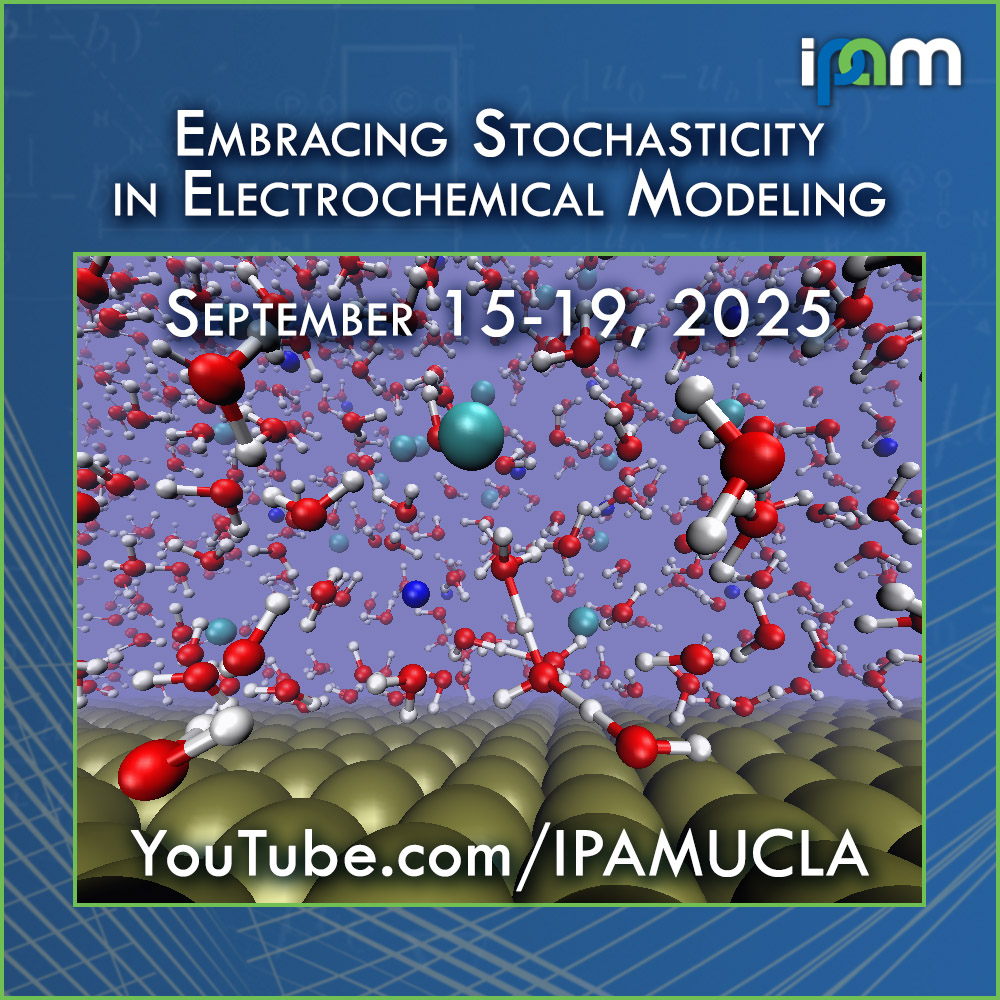
Recorded 18 September 2025. Nicolas Hörmann of the Fritz-Haber-Institut der Max-Planck-Gesellschaft presents "Bias In, Physics Out: Ab-Initio Insights into Electrified Interfaces" at IPAM's Embracing Stochasticity in Electrochemical Modeling Workshop.
Abstract: Electrified solid–liquid interfaces govern electrocatalysis, corrosion, and energy storage, yet embedding the applied electrode potential and the charging of the electrical double layer into ab-initio simulations remains a central challenge. A rigorous treatment calls for variable-charge, constant-potential simulations with countercharges that faithfully reproduce double-layer physics which is computationally demanding at the ab-initio level. As a pragmatic alternative, surface-science–inspired strategies have gained traction: coarse-grained or implicit electrolyte descriptions coupled to a quasi-static, explicit treatment of electrode atoms and a limited set of chemisorbed adsorbates.
I will review how such models have been used to predict potential- and pH-dependent surface compositions, simulate cyclic voltammograms, and estimate electrochemical reaction barriers under bias, highlighting where they succeed and what observables—such as the exchanged charge—can be extracted.
I will also examine their limitations, especially those arising from the absence of an explicit, responsive liquid environment. Using recent work on the capacitance of Pt(111) in water [1], I will show that reproducing and rationalizing experimental trends requires explicit liquid structure and dynamics with ab-initio accuracy at applied bias. Finally, I will introduce RAZOR [2], a response-augmented machine-learning potential that incorporates first- and second-order energy responses to bias via learned work-function and local Born-effective-charge information. RAZOR enables large-scale molecular dynamics at finite bias charge and promises to bridge constant-potential physics with the system sizes and timescales needed to interrogate interfacial structure, kinetics, and spectroscopy.
[1] Li, Eggert, Reuter, Hörmann, JACS, 147(26), 22778–22784 (2025)
[2] Bergmann, Bonnet, Marzari, Reuter, Hörmann, under review (2025)
Learn more online at: https://www.ipam.ucla.edu/programs/workshops/workshop-i-embracing-stochasticity-in-electrochemical-modeling/?tab=overview